
Our Work · RESEARCH
South African Citrus Into Europe
 South African Citrus Into Europe
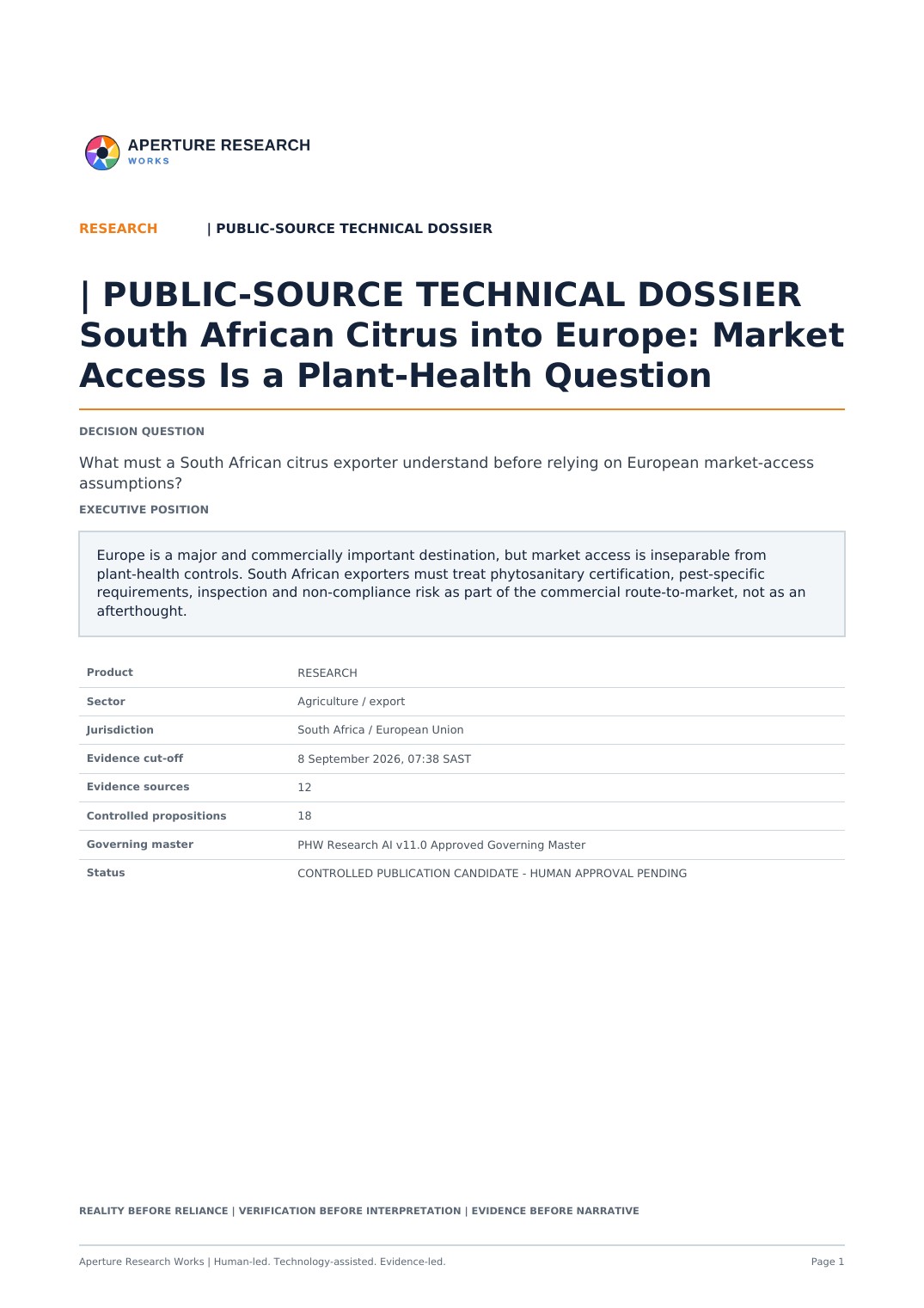
What must a South African citrus exporter understand before relying on European market-access assumptions?
Decision question
What must a South African citrus exporter understand before relying on European market-access assumptions?
What the public record supported
WTO disputes concerning EU citrus controls are distinct from the operative phytosanitary requirements governing a specific consignment. A legal challenge is not a customs clearance or judgment of illegality.
Material findings
- South Africa sought consultations in WTO dispute DS613 in July 2022 over EU restrictions affecting citrus imports. [C1]
- A separate WTO dispute, DS624, was initiated in April 2024 and concerns additional EU measures related to citrus black spot. [C2]
- The WTO records two dispute panels established in July 2024; panel formation is not a decision that the EU rules breach WTO law. [C3]
Documentary source references
Additional verification required before reliance
- Current EU Implementing Regulation, product code and destination port.
- Orchard pest status, plant-health treatment and country export controls.
- Phytosanitary certificate, cold-treatment log and packhouse traceability.
- Date-specific EU alert/inspection restrictions and consignee status.
- Qualified plant-health specialist legal and operational sign-off.
Boundaries
- Plant-health compliance and trade-law proportionality are different questions.
- A national shipment success rate says nothing about the exact orchard or consignment.
- WTO allegations are not adjudicated findings.
How this demonstrates Aperture capability
This demonstration shows how Aperture frames a decision question, traces material claims to external evidence, separates what is established from what remains uncertain, and keeps the reliance boundary visible. It is designed to demonstrate the research and evidence method rather than imply a client engagement.
Relevant buyer context: Exporters, advisers and supply-chain teams.
Scenario: Export market-access evidence.
Research PDF and source register
5 traced propositions · 3 source anchors · 7-page October 2026 public-source dossier
The download documents source-limited findings, newer official records, case-specific adversarial review, a defined research workplan and decision-relevant unresolved evidence. Historical expanded dossiers are retained separately for internal control and not claimed to have been exhaustively re-verified.